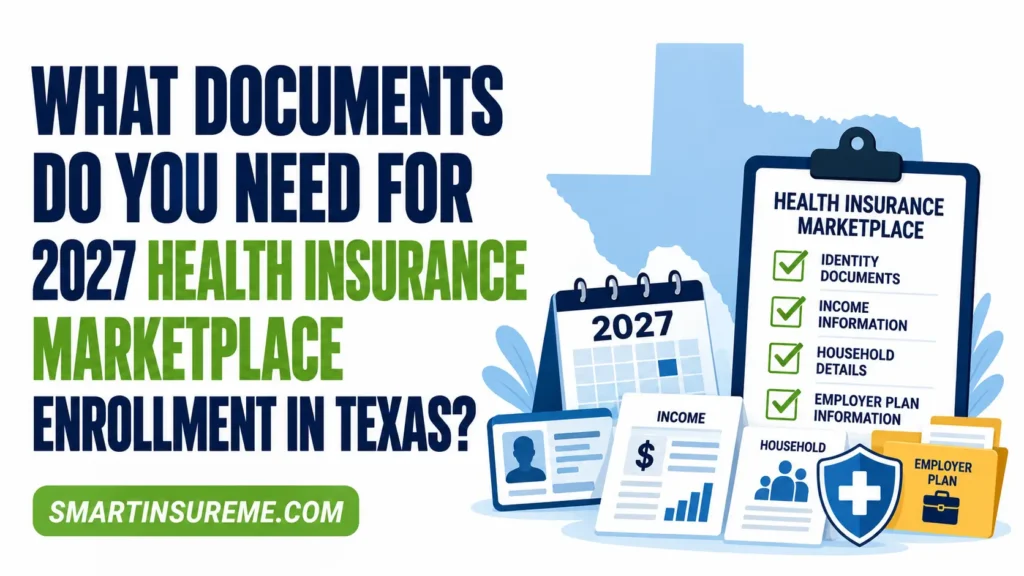
To apply for 2027 Health Insurance Marketplace coverage in Texas, you should prepare information about your household, Social Security numbers when applicable, immigration documents for applicants who use them, expected 2027 income, current health coverage, and any employer-sponsored insurance available to household members. You may not need to upload every document when you first apply, but having the information ready can make enrollment faster and help avoid delays if HealthCare.gov asks you to verify something later. HealthCare.gov specifically recommends using its application checklist before Open Enrollment.
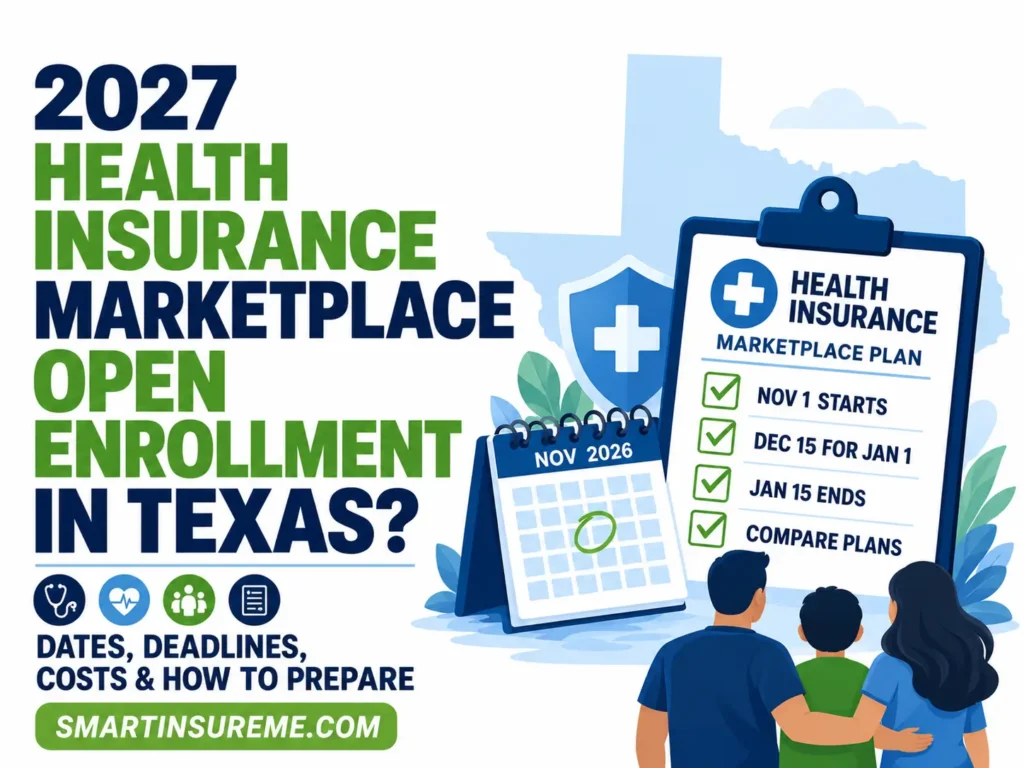
Texas residents use the federal Marketplace at HealthCare.gov. For 2027 coverage, Open Enrollment begins November 1, 2026, so now is a good time to gather your information rather than waiting until the application is open. Smart Insurance’s 2027 Health Insurance Marketplace Open Enrollment in Texas guide explains the key dates and deadlines in more detail.
Documents Needed for 2027 Marketplace Enrollment
The Marketplace application asks questions about the people in your household, your expected income, and other health coverage available to you. HealthCare.gov uses this information to determine whether you can enroll in a Marketplace plan and whether you may qualify for financial help.
Before starting your application, gather the following:
- Household information: Names, dates of birth, home address, and details for the people you include on your federal tax return.
- Social Security numbers: People applying for coverage should provide a Social Security number if they have one. HealthCare.gov may also ask for a tax filer’s Social Security number when tax information is used to verify eligibility for savings.
- Immigration information: Lawfully present immigrants applying for coverage may need information from eligible immigration documents.
- Expected 2027 income: Recent pay information, self-employment estimates, Social Security income, investment income, or other income that may need to be included in the Marketplace calculation.
- Current health coverage: Information about Marketplace, employer, COBRA, Medicare, Medicaid, CHIP, or other health coverage currently available to household members.
- Employer coverage details: Information about any health plan offered through a job, including coverage available to the employee and family members.
HealthCare.gov may verify information with agencies such as Social Security, the IRS, the Department of Homeland Security, employers, Medicaid, and other coverage programs.
Personal and Household Information
Your Marketplace household is not always simply everyone who lives at your address. In many cases, it is based on your tax household.
HealthCare.gov says Marketplace income calculations generally include you, your spouse, and tax dependents whose income must be counted under Marketplace rules. Even if a household member does not need health insurance, their information may still matter when calculating eligibility for savings.
Review your household before you apply. Marriage, divorce, a new baby, a dependent moving out, or a change in who you claim on your tax return can affect your Marketplace application.
For Texans who want help comparing individual or family coverage, Smart Insurance’s Health Insurance in Texas page explains common coverage options and what to compare.
Proof of Income and Expected 2027 Income
One of the most important parts of your application is your expected household income for 2027.
HealthCare.gov states that Marketplace savings are based on your expected income for the year you want coverage, not simply what you earned last year.
That means your 2026 tax return can be useful as a starting point, but it may not tell the full story if you expect a raise, job change, reduced hours, self-employment income, retirement, or another significant change during 2027.
If you are employed, have recent pay information available. If you are self-employed, prepare a reasonable estimate of your expected net income. The Marketplace may ask for additional verification when the income information you provide cannot be confirmed electronically.
The goal is not to guess perfectly. It is to provide the best reasonable estimate you can and update your Marketplace application if your income changes during the year.
Employer Health Coverage Information
If you or someone in your household has access to health insurance through an employer, the Marketplace may need information about that offer.
This matters because access to qualifying employer coverage can affect eligibility for Marketplace financial assistance.
Have information ready about who is eligible for the employer plan, what the employee would pay, and when the coverage is available. HealthCare.gov may verify employer-sponsored coverage information with the employer listed on your application.
Do not assume you cannot use the Marketplace simply because an employer offers insurance. Apply with accurate information and let HealthCare.gov determine your eligibility.
Immigration Documents, If Applicable
People who are lawfully present in the United States may be eligible for Marketplace coverage.
If an applicant uses immigration status to establish eligibility, have the relevant document information available. HealthCare.gov explains that immigration information is used to determine eligibility and administer Marketplace programs. Household members who are not applying for coverage do not need to provide citizenship or immigration status solely because another family member is applying.
Use the exact information shown on the immigration document to reduce verification problems.
Current Health Insurance Information
If anyone in your household currently has health coverage, have that information ready.
This could include employer insurance, an existing Marketplace plan, COBRA, Medicaid, CHIP, Medicare, or another source of coverage.
People renewing Marketplace coverage should not simply leave last year’s application unchanged. HealthCare.gov recommends updating your expected income and household information for the new coverage year before comparing plans.
If you are considering ending an old Marketplace plan after moving to another form of coverage, Smart Insurance’s guide to canceling Marketplace health insurance in Texas can help you understand the process and avoid creating an unintended gap.
Doctors and Prescriptions to Check Before Choosing a Plan
These are not usually documents required to complete your Marketplace application, but they are worth preparing before you choose a plan.
Write down your regular doctors, specialists, hospitals, and prescription medications. Then compare each plan’s provider network and drug coverage.
A low monthly premium does not always mean the plan will cost you less overall. Deductibles, copays, coinsurance, provider networks, and prescription coverage can make a major difference in what you actually spend during the year.
Smart Insurance helps Texas individuals and families compare these plan details based on healthcare needs and budget.
What If HealthCare.gov Asks for More Documents?
Do not panic if the Marketplace asks you to verify information after you submit your application.
HealthCare.gov may request documents when it cannot confirm certain information electronically. For Special Enrollment Periods, for example, applicants may need to provide proof of a qualifying life event such as loss of coverage. HealthCare.gov provides instructions in the Marketplace Eligibility Notice and allows documents to be uploaded online.
Read every notice in your Marketplace account carefully and respond before the stated deadline.
If you qualify for a Special Enrollment Period because of a life event, you generally have a limited enrollment window. HealthCare.gov says many qualifying events provide about 60 days to enroll, though specific rules depend on the event.
Common Marketplace Application Mistakes to Avoid
A smooth application is mostly about accuracy and preparation.
Double-check names, dates of birth, Social Security information, household members, employer coverage, and expected income before submitting. Avoid using last year’s income without considering what you actually expect to earn in 2027.
Also, do not ignore Marketplace notices after enrolling. If your income, household, address, or coverage changes during the year, update your application so your eligibility and savings remain as accurate as possible.
Cómo puede ayudar un seguro inteligente
The Marketplace application can feel complicated when you are dealing with household changes, employer coverage, income estimates, or multiple health plan choices.
Smart Insurance helps Texas residents understand available health insurance options and compare plans based on doctors, prescriptions, deductibles, premiums, and household needs. You can review Smart Insurance’s health insurance services o contact the Smart Insurance team if you want help preparing for 2027 Open Enrollment.
Preguntas frecuentes
Do I need to upload all my documents when I apply?
Not necessarily. Much of the information on a Marketplace application may be verified electronically. If HealthCare.gov needs additional proof, your Eligibility Notice will explain what to provide and how to submit it.
Do I need my 2026 tax return to apply for 2027 coverage?
It can help you estimate income, but Marketplace savings are based on your expected 2027 household income, not simply your prior-year income.
When does 2027 Marketplace Open Enrollment begin?
Open Enrollment begins November 1, 2026. Enroll by December 15 for coverage that can start January 1. Open Enrollment ends January 15.
What happens if my income changes after I enroll?
Update your Marketplace application when your expected household income changes. This helps HealthCare.gov calculate the correct amount of savings for your situation.
Conclusión final
Preparing your documents needed for Health Insurance Marketplace enrollment before November 1 can make the process much easier.
Gather your household details, expected 2027 income, Social Security or immigration information when applicable, employer coverage details, and current insurance information. Then prepare a separate list of your doctors and medications so you can compare plans more carefully.
The official HealthCare.gov preparation checklist is a good place to start, and Smart Insurance can help Texas residents understand their coverage options before they choose a plan.